
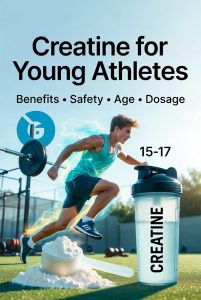
Creatine has become one of the most researched and widely used dietary supplements in sports nutrition. For young athletes—middle school, high school, and even some junior competitors—questions swirl around whether it’s safe, effective, or even necessary. Parents, coaches, and athletes themselves often wonder: Does creatine really boost performance in developing bodies? At what age is it appropriate? And how much should someone take without risking long-term harm?
The short answer, backed by a growing body of evidence including recent position stands from the International Society of Sports Nutrition (ISSN), is that creatine monohydrate is among the safest and most effective ergogenic aids available. It is not a steroid, hormone, or “performance-enhancing drug” in the banned sense. It is a naturally occurring compound that supports cellular energy production. While some older guidelines from pediatric organizations like the American Academy of Pediatrics (AAP) have historically advised against use under age 18 due to limited long-term data at the time, more recent systematic reviews and lifespan analyses paint a far more reassuring picture: creatine appears well-tolerated in healthy adolescents, with potential benefits for strength, power, recovery, and even injury risk reduction when used responsibly alongside proper training and nutrition.
This article explores the science, real-world application, benefits, risks, age considerations, and practical protocols for creatine use in young athletes aged roughly 12–18. It draws from peer-reviewed studies, position stands, and clinical data to provide a balanced, evidence-based guide. The goal is not to push supplementation but to empower informed decisions—because young athletes are still growing, and the foundation should always be fundamentals: sleep, training, whole-food nutrition, and hydration.
How Creatine Works: The Science in Simple Terms
Creatine is synthesized in the liver, kidneys, and pancreas from the amino acids arginine, glycine, and methionine. About half comes from the body’s own production; the rest comes from diet—primarily red meat and seafood (roughly 1–2 grams per day for non-vegetarians). Once in the muscles, about 95% of the body’s creatine is stored as phosphocreatine (PCr). During short, explosive efforts—like a sprint, jump, tackle, or heavy lift—PCr donates a phosphate group to regenerate adenosine triphosphate (ATP), the cell’s primary energy currency. This process happens almost instantly, fueling the first 5–15 seconds of all-out effort before other energy systems kick in.
Supplementation increases muscle creatine stores by 20–40% (depending on baseline levels and diet). Vegetarians or those with lower dietary intake often see bigger gains. The result: more fuel for repeated high-intensity bursts, faster recovery between sets or sprints, and greater training capacity over time. For young athletes in sports like soccer, basketball, football, swimming, track sprints, or wrestling, this can translate to meaningful performance edges.
Importantly, creatine also draws water into muscle cells (cell volumization), which may support protein synthesis and reduce breakdown. Emerging data even suggest neuroprotective effects, potentially buffering the brain against concussion-related trauma—a relevant concern in contact sports.
Proven Benefits for Young Athletes
Research on adolescents is not as voluminous as on adults, but the available data—spanning randomized controlled trials in swimmers, soccer players, and other youth athletes—is promising. A 2021 review by Jagim and colleagues noted consistent improvements in anaerobic performance, sprint times, power output, and sport-specific skills with no reported adverse events.
Specific benefits include:
• Strength and Power Gains: Studies show increases in bench press, squat, and vertical jump performance. In one trial with adolescent soccer players, creatine improved dynamic strength and repeat sprint ability.
• Anaerobic Endurance: Swimmers using creatine demonstrated faster sprint swim times and better swim-bench power. Repeat sprint performance in intermittent sports improved, which is critical for games with frequent stop-and-go action.
• Muscle Mass and Body Composition: While adolescents naturally gain lean mass during puberty, creatine can amplify training-induced gains. It supports lean tissue without the hormonal risks of other supplements.
• Recovery and Injury Reduction: Creatine may blunt muscle damage, speed glycogen replenishment when paired with carbs, and lower cramping/injury rates. In football players (including some collegiate-age youth data), creatine users had fewer injuries.
• Potential Cognitive and Neuroprotective Perks: High-intensity training and contact sports stress the brain. Creatine supports brain energy metabolism and may aid recovery from mild traumatic brain injury.
A 2023 literature review of 13 studies (268 subjects, mean age 11.5–18.2 years, mostly soccer/swimmers) found short-term benefits for explosive movements, though results were not always consistent across all performance metrics due to natural growth spurts in youth. Overall quality of evidence was rated as needing more high-quality trials, but acute safety concerns were largely eliminated.
Importantly, benefits are most pronounced in athletes already training hard with high-intensity sessions. Creatine is not a shortcut for under-trained or poorly nourished kids; it augments a solid foundation.
Safety Profile: What the Data Actually Shows
This is where myths meet facts. Older AAP statements (circa 2001) discouraged use under 18, citing unknown long-term safety. At the time, data were sparse. Fast-forward to 2025: the ISSN’s updated stance and multiple reviews conclude creatine is safe across the lifespan—including children and adolescents—when used at evidence-based doses.
Key safety findings:
• No Adverse Clinical Markers: Systematic reviews of adolescent athletes found zero reports of gastrointestinal distress, hemodynamic changes, or alterations in blood/urine markers of kidney, liver, or heart function. Studies lasted weeks to years with doses up to 0.3 g/kg loading and 3–5 g/day maintenance.
• Pediatric Clinical Use: Creatine has been safely given to infants and children with creatine synthesis deficiencies or muscular dystrophy at much higher doses (0.1–0.8 g/kg/day) for months to years, with clinical improvements and no serious side effects.
• Common Side Effects: The main one is modest water retention causing 1–2 kg (2–4 lbs) weight gain—usually beneficial for muscle fullness. Rare mild stomach upset occurs if powder isn’t fully dissolved or taken on an empty stomach. No evidence links it to kidney damage in healthy individuals (a common myth debunked by hundreds of studies). Dehydration risk is theoretical; staying hydrated mitigates it.
• Long-Term Data: Up to 5+ years of use in various populations shows no issues. Dietary creatine intake in youth correlates positively with height, lean mass, and bone density.
Conservative voices (some pediatricians, Children’s Hospital guidelines) still recommend prioritizing whole foods and training before supplements, noting supplements aren’t FDA-regulated for purity. This is prudent advice. Contaminated products exist, so third-party testing (NSF Certified for Sport, Informed-Sport) is non-negotiable.
At What Age Should Young Athletes Start Creatine?
There is no universal “minimum age” stamped by science. Traditional pediatric guidelines (AAP, some sports medicine groups) still say “not under 18” due to historical caution and the fact that puberty drives massive natural gains in muscle and performance.
However, the latest evidence from sports nutrition experts challenges blanket restrictions:
• Adolescent studies (ages 13–18) show benefits and safety with no adverse events.
• Clinical pediatric use extends to much younger ages safely.
• The 2025 ISSN/Frontiers analysis argues that restricting creatine to minors may actually harm growth, maturation, and injury resilience in athletes with low dietary intake. They recommend 2–3 g/day for general health in all ages.
Practical consensus emerging among researchers like Dr. Andrew Jagim and ISSN members: Creatine can be appropriate for competitive adolescent athletes (roughly 14–18) who are already training seriously, eating well, and under supervision of a physician or sports dietitian. It is generally unnecessary—and not recommended—for pre-pubertal children or casual middle-school athletes whose bodies are already adapting rapidly to training.
Bottom line: Focus on basics until at least mid-teens. If an athlete is 15+, plays a high-intensity sport, has a balanced diet low in red meat, and wants an edge, discuss with a doctor. Individualize—vegetarians, those in calorie deficit, or recovering from injury may benefit earlier.
How Much Creatine? Dosage Protocols for Youth
The science is clear: you don’t need megadoses. Muscle saturation occurs efficiently with modest amounts.
Standard Protocol (Most Common and Evidence-Based for Teens):
• Maintenance Dose Only (No Loading): 3–5 grams per day. This raises muscle stores over 3–4 weeks and is the simplest, most studied approach for adolescents. Many studies used exactly this with success.
• Optional Loading Phase (for faster results): 0.3 g/kg body weight per day (divided into 4 doses) for 5–7 days, followed by 0.03 g/kg or 3–5 g/day maintenance. For a 60 kg (132 lb) athlete: ~18 g/day loading, then ~2 g maintenance (rounded to 3–5 g).
• Timing: Any time of day works. Post-workout with a carb/protein meal may slightly enhance uptake, but consistency matters more than perfect timing.
• Cycling: Not necessary. Long-term daily use is safe and maintains benefits.
• Form: Creatine monohydrate powder is the gold standard—cheap, effective, most researched. Avoid fancy “buffered” or liquid forms unless third-party tested; they offer no proven superiority.
Adjust for body weight: Smaller athletes (under 50 kg) may stay at 3 g/day. Larger ones (over 80 kg) can use 5 g. Always mix thoroughly in 8–12 oz liquid.
Practical Considerations and Best Practices
1. Prioritize Fundamentals: Creatine amplifies results—it doesn’t create them. Ensure 1.6–2.2 g/kg protein daily, sufficient calories, 8–10 hours sleep, progressive training, and hydration (extra water with creatine).
2. Medical Clearance: Get a physical. Screen for kidney issues (rare in healthy teens but important).
3. Quality Control: Buy NSF/Informed-Sport certified. Avoid multi-ingredient “stacks” with unproven additives.
4. Monitoring: Track performance, body weight, energy, and any GI issues. Bloodwork (if recommended by doctor) can reassure on kidney markers.
5. Special Populations: Females may see similar benefits without hormonal interference. Vegetarian/vegan athletes often respond exceptionally well.
6. Cost and Accessibility: A month’s supply of quality monohydrate costs $5–10—far cheaper than many energy drinks or protein bars.
Common myths debunked: Creatine does not cause hair loss, acne, “roid rage,” or stunt growth. It is not banned by NCAA, high school associations, or WADA.
Conclusion: A Tool, Not a Crutch
Creatine supplementation offers real, evidence-backed benefits for young athletes in high-intensity sports—improved power, strength, recovery, and potentially lower injury risk—with an excellent safety profile when used correctly. While older conservative guidelines urged waiting until 18, current science from systematic reviews and major sports nutrition bodies supports its use in supervised adolescents as young as mid-teens, especially those with low dietary creatine intake.
That said, no supplement replaces hard work. The vast majority of young athletes will see bigger gains from optimizing training, nutrition, and recovery than from any powder. If creatine fits into a well-rounded plan under professional guidance, it can be a smart, low-risk addition. Always consult a physician or registered sports dietitian before starting—individual needs vary.
Parents and coaches: Educate, don’t dictate. Young athletes are watching how we model science-based decisions. With responsible use, creatine can help today’s athletes train harder, recover better, and stay in the game longer—without compromising long-term health.